

5 Reasons to Use Zero Trust Architecture
Quick Answer:
- Zero Trust Architecture follows the “never trust, always verify” principle by continuously authenticating users, devices, and applications.
- It reduces cyber risk through least-privilege access, continuous verification, and stronger visibility across the network.
- Organizations usually implement Zero Trust in phases: assessment, planning, deployment, and ongoing optimization.
Why Traditional Security No Longer Works
Traditional security models assumed that users and devices inside the corporate network could be trusted. However, today’s workforce accesses business applications from remote locations, personal devices, cloud platforms, and SaaS applications.
| Traditional Security | Zero Trust Security |
|---|---|
| Trusts users inside the network | Verifies every access request |
| One-time authentication | Continuous authentication and verification |
| Broad network access | Least-privilege access |
| Perimeter-focused security | Identity-focused security |
| Reactive threat detection | Continuous monitoring and threat detection |
Zero Trust replaces this outdated approach by continuously verifying every access request, regardless of where it originates. Instead of granting broad network access after a single login, Zero Trust enforces least-privilege access, continuously validates user identity and device security, and monitors activity throughout each session to reduce the risk of unauthorized access and cyberattacks.
What Is Zero Trust Architecture?
Zero Trust Architecture (ZTA) is a cybersecurity framework that authenticates and validates users, devices, applications, and network traffic before granting or maintaining access to organizational resources.
At a high level, Zero Trust Architecture can be summed up by the phrase “never trust, always verify.” This means that the detection and prevention for each component can improve assurance for the system as well as the software while defending against malicious actors.
According to NIST, Zero Trust is defined as “a collection of concepts and ideas designed to minimize uncertainty in enforcing accurate, least privilege per-request access decisions in information systems and services in the face of a network viewed as compromised.”
Under a Zero Trust framework, security properties are verified dynamically to ensure that the expected authentication and verification controls are met. Each component that is built with Zero Trust in mind is engineered to recognize if the adjoining or adjacent components may possess any vulnerabilities. Seeing as how each individual component in a stack comes with its own trust level, it may be able to detect an attempted attack or possible compromise before it occurs.
So how can your IT teams manage the deployment and implementation of a Zero Trust Architecture and still maintain assurance of its effectiveness? Let’s break it down.
Principles of Zero Trust
In general, most zero trust architectures are made up of a complex combination of infrastructure, firmware, software and data that relies on the isolation of parts or services from one another for infrastructure assurance.
According to information released in the NIST CSRC publication SP 800-207, some of the main points behind Zero Trust include:
- Access to resources is determined by dynamic policy
- All communication is secured regardless of location
- Access to individual enterprise resources is granted on a per-session basis
- All data sources and computing services are considered resources
- All owned and associated devices are in the most secure state possible
- All resource authentication and authorization are dynamic and strictly enforced
- Collect as much information as possible on current state of network infrastructure to improve security posture
By applying the most extreme security controls possible to anything your team may be working on (data, infrastructure, apps, network) you are removing any accountability the end user may have, therefore establishing the model known as “Zero Trust.”
| Principle | Business Benefit | Real-World Example |
|---|---|---|
| Access to resources is determined by dynamic policy | Reduces unauthorized access by evaluating each request based on identity, device health, location, and risk. | An employee logging in from an unfamiliar country is required to complete additional verification before accessing company data. |
| All communication is secured regardless of location | Protects data whether employees work in the office, remotely, or from public Wi-Fi. | A remote employee securely accesses cloud applications over an encrypted connection from a coffee shop. |
| Access is granted on a per-session basis | Prevents long-lived sessions from being exploited if credentials are compromised. | A user must re-authenticate before accessing payroll data after an extended period of inactivity. |
| All data sources and computing services are considered resources | Ensures every application, database, and cloud service receives the same level of protection. | Access to a cloud CRM and an on-premises database is governed by the same Zero Trust policies. |
| All owned and associated devices are in the most secure state possible | Prevents compromised or outdated devices from accessing sensitive systems. | A laptop missing critical security updates is blocked until it complies with company security policies. |
| Authentication and authorization are continuously enforced | Detects suspicious activity during a session and limits the impact of compromised accounts. | If a user’s behavior suddenly changes, such as downloading unusually large amounts of data, access can be suspended automatically. |
| Continuously collect security telemetry | Improves threat detection, incident response, and compliance through ongoing monitoring. | Security teams receive alerts when unusual login patterns indicate a possible account compromise. |
Zero Trust Architecture Components
Zero Trust Architecture combines multiple security components to verify access and protect users, devices, applications, data, networks, and infrastructure. The components of zero trust architecture (each one of them) play a specific role in reducing risk and preventing unauthorized access.
| Component | Role in Zero Trust |
|---|---|
| Identity | Verifies the identity of every user through authentication methods such as multi-factor authentication (MFA) before granting access. |
| Devices | Ensures laptops, smartphones, servers, and other endpoints meet security requirements before they can connect to organizational resources. |
| Applications | Restricts application access based on user identity, role, and security policies instead of network location. |
| Data | Protects sensitive data through encryption, access controls, and continuous monitoring to prevent unauthorized access or data loss. |
| Network | Segments the network into smaller trust zones to limit lateral movement and reduce the impact of a security breach. |
| Infrastructure | Applies Zero Trust controls across on-premises systems, cloud environments, virtual machines, and containers to secure critical infrastructure. |
| Monitoring | Continuously monitors users, devices, applications, and network activity to detect suspicious behavior and respond to threats in real time. |
Zero Trust in Action
Consider an employee working remotely who needs to access a company CRM from a personal laptop. Instead of granting access after a successful login, a Zero Trust system verifies the user’s identity with multi-factor authentication (MFA), checks that the device meets security requirements, and evaluates contextual factors such as location and device health.
If suspicious activity is detected during the session, access can be restricted or revoked immediately, helping prevent unauthorized access and potential data breaches.
Benefits of Zero Trust
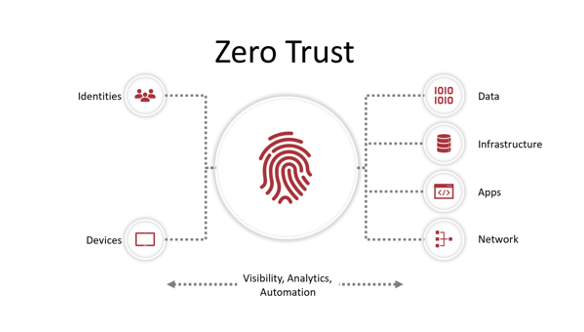
Zero Trust can manage user access to applications, data and devices while improving visibility and control. There are many benefits of Zero Trust, including increasing visibility, reducing dwell time and providing consistent proof that your data is safe and sound. Based on research into the data-centric world of endpoint security, here are five key benefits of Zero Trust Architecture for organizations.
Proven to Work
Many businesses rely on Zero Trust Architecture to maintain their integrated, end-to-end security posture. Zero Trust can help identify security vulnerabilities with unified endpoint management that’s proven to work in multiple-use cases.
In the event of a security breach, Zero Trust also limits lateral movement by enforcing least-privilege access and continuously verifying users and devices. This helps contain threats, preventing attackers from moving freely across the network or accessing additional systems and sensitive data.
Simplified Security Solutions
Any organization can streamline and strengthen their cloud security by using Zero Trust to replace disparate products with a scalable security framework that consolidates endpoint detection, response and protection into one.
Zero Trust can also be applied across multiple systems while enabling more secure identity and access management. It further simplifies security through centralized identity management, conditional access policies, and policy automation. These features help IT teams centrally manage identities, apply risk-based access controls, and automatically enforce consistent security policies across all users, devices, and applications.
Reduced IT Costs
Forrester Research found that Zero Trust can mitigate an organization’s risk exposure by at least 37 percent and reduce security costs by 31 percent, saving not only time and money but wasted energy on unnecessary IT expenditures.
By reducing the likelihood and impact of security incidents, minimizing manual security tasks through automation, and streamlining identity and access management, organizations can also lower operational costs and improve IT efficiency over time.
Improved User Behavior
Zero Trust forces users to be secure at all levels of connecting to company data. They will naturally compare what they do with other parts of their life and hopefully, improve their security posture.
By encouraging the use of phishing-resistant authentication methods, such as passkeys or hardware security keys, along with multi-factor authentication, Zero Trust helps users adopt stronger security habits while reducing the risk of credential theft and unauthorized access.
Reinforce Best Practices
Instead of IT teams submitting a request to open a firewall port to a particular address, Zero Trust allows users to investigate their request directly, assess what it will be used for and who uses it.
Zero Trust also supports compliance with widely recognized security frameworks and regulations, including NIST, CMMC, HIPAA, and PCI DSS, by enforcing strong identity verification, least-privilege access, and continuous monitoring.
In addition, many cyber insurance providers increasingly consider these security controls when evaluating an organization’s cyber risk and determining coverage requirements or premiums.
Zero Trust Implementation Checklist
Use this checklist to help plan and prioritize your Zero Trust implementation.
| Task | Priority |
|---|---|
| Enable Multi-Factor Authentication (MFA) | High |
| Inventory All Devices | High |
| Remove Excessive Permissions | High |
| Encrypt Sensitive Data | High |
| Implement Conditional Access | High |
| Segment Networks | Medium |
| Monitor User Activity | Medium |
| Conduct Regular Access Reviews | Medium |
| Train Employees on Security Awareness | Ongoing |
| Review Security Policies Quarterly | Ongoing |
Conclusion
Due to the increasing complexity of network environments and the ability of malicious actors to compromise them, implementing Zero Trust requires a change in defensive strategy, as well as a shift in focus.
According to the National Security Agency, using a Zero Trust model to secure a data center, public cloud and endpoints can definitively prevent the propagation of a ransomware attack, which subsequently reduces downtime for a business.
The Zero Trust mindset focuses on securing critical data and access paths by eliminating trust as much as possible, coupled with verifying and regularly re-verifying every allowed access. However, implementing Zero Trust should not be taken lightly and will require significant resources and persistence to achieve.
When properly implemented, Zero Trust can prevent, detect and contain threats faster and more effectively than the more traditional cybersecurity architectures currently still held in place by many organizations.
Implementing an end to end Zero Trust strategy enables organizations to build a resilient cybersecurity posture across their entire digital environment.
Applying Zero Trust in the data center strengthens security for critical workloads, limits lateral movement, and protects on-premises and hybrid environments from evolving cyber threats.
To stay safe in a world of evolving and ever-present dangers, companies can start proactively detecting the malicious threats of tomorrow before they occur by implementing a Zero Trust model today.
Frequently Asked Questions

written by
Red River
We call ourselves a technology transformation company because we know how to harness the power of technology to change the way you do business and meet mission objectives. Our industry leading technical expertise, strategic partnerships and portfolio of services and solutions that span the entire lifecycle of technology have made us the partner of choice for clients in the commercial, federal and SLED markets interested in optimizing business processes and maximizing the value of their investments. Learn more about Red River.